Best Yarn for Crochet Beginners: Read the Label, Not the Brand
The four label specifications that decide whether a yarn is good to learn on, the three you should ignore, and the cheap mid-grade acrylic combination that gives you the cleanest beginner experience.
On this page16 sections▾
The internet is full of "best beginner yarn" lists that name three specific yarns from three specific brands and stop there. Those lists are also half wrong by the time you read them (the yarns get reformulated, the colors change, the prices move), and they don't teach you what to do once those specific yarns aren't on the shelf.
The actual answer is four label specifications. If the yarn meets all four, it's fine to learn on, regardless of brand. If it doesn't, swap it.
The four specs are: weight 4 (worsted), smooth construction, solid medium-light color, and acrylic or cotton fiber under twenty dollars per skein. That's the whole rule. Everything else on a yarn label, including the brand name, is irrelevant to whether the yarn is good to learn on.
This guide breaks down each criterion, says what each one is doing for you, and gives two practice projects to test the rules on.
Spec 1: Weight 4 (worsted)
The single most important criterion. Worsted weight is the medium-thick yarn used in most beginner patterns and most yarn-store displays. The CYC label number is 4.
What worsted does for a beginner: the stitches are big enough to see clearly. You can tell which loop is the top of the stitch, which loop is the back bar, where the hook is supposed to insert. Smaller yarns (sport, fingering, lace) hide stitch structure under tighter gauge; larger yarns (bulky, super-bulky) are faster but show every tension variation as a visible defect.
The choice between worsted and bulky for absolute first projects depends on what you're prioritizing. Worsted teaches stitch identification and is the weight you'll use for years. Bulky teaches fast-progress confidence: a finished cowl in two hours, a finished blanket in a weekend. The argument for worsted as the first weight is that anything you learn on worsted transfers to bulky later; the reverse is less true because bulky's giant stitches don't teach the same fine motor skills.
Default recommendation: start on worsted. Add a bulky project after the first one or two if you want a fast win.
Spec 2: Smooth construction
The yarn should feel like a smooth strand when you run it between your fingers, with no fuzz, no bumps, no extra strands sticking out.
Why this matters: textured and novelty yarns hide stitch definition. When you can't see your stitches, you can't see where to insert the hook, and you can't tell whether your tension is even. Eyelash yarn, boucle, ribbon yarn, faux-fur yarn, and most "art yarns" are all bad to learn on for the same reason: they're optimized for visual interest in the finished fabric, not for stitch legibility while you work.
What to look for at the shop: hold the yarn up. Can you see a clean, defined strand? Run it through your fingers. Does it feel like one cohesive thread or like a tangle of fluff? The smoother and more visible the strand, the better the learning yarn.
What to skip: anything labeled "novelty," "fuzzy," "boucle," "textured," "eyelash," or "art yarn." Also skip thick-and-thin handspun for the same reason; the inconsistent thickness produces inconsistent stitches that don't teach you anything about your own tension.
Spec 3: Solid medium-light color
The crochet stitches you make are dark loops against the yarn's color. If the yarn is dark (navy, black, charcoal), the loops disappear into the color and you literally cannot see your work. If the yarn is variegated (multiple colors changing along the strand), the color changes obscure the stitch structure for similar reasons.
What to look for: a solid color, light or medium tone. Light gray, cream (not pure white, which is hard on the eyes), warm beige, soft blue, sage green, dusty rose, mustard. Any of these reads cleanly against the dark loop of the hook and the dark shadow of the stitches you're making.
What to skip: pure white (eye strain), pure black (loops invisible), dark navy, very dark purple, very dark green. Also skip variegated yarn for first projects. Self-striping yarn (where the color changes are predictable and even) is fine after the first few projects; random multi-color is harder to learn on.
The temptation to pick a sophisticated dark yarn for your first project is real and should be resisted. Use a light color you'd otherwise consider boring; you can graduate to navy later.
Spec 4: Acrylic or cotton, under twenty dollars per skein
Your first projects will fail. You'll frog them (pull them out) at row 8, redo, frog again, redo, give up halfway, restart a week later. The yarn needs to survive this without making you weep over the cost.
Acrylic survives frogging well. It's smooth, doesn't fuzz when pulled back through stitches, doesn't pill from handling. It washes in a machine. It's cheap. The criticism of acrylic (it's plastic, it doesn't breathe, it doesn't biodegrade) is valid for finished garments meant to last decades, but it's the wrong criticism for practice yarn that's going to live one project before being given away or repurposed.
Cotton also works. It's denser than acrylic in the hand, slightly less forgiving on tension errors, and shows stitch definition extremely clearly. The downside is that cotton frogs less cleanly than acrylic; pulled-out cotton stitches kink and don't quite recover. Use cotton for projects you're committed to finishing; use acrylic for projects you're still figuring out.
The price ceiling is loose but real. Anything over twenty dollars per skein is too expensive for a first project. Save the expensive merino, the hand-dyed indie wool, and the silk-blend luxury yarns for after you're past the failure rate of the first year.
What to skip
The complement of the above four rules:
Anything labeled "delicate," "handwash only," or "lay flat to dry." First projects need to survive machine washing because they'll get tested by real use; precious-handling yarns make the testing scary.
Anything where the label specifies a hook size finer than 5mm. That puts you below worsted weight; you don't want that yet.
Anything where the put-up is a cone, a hank, or anything other than a ready-to-use skein or ball. Cones save money per yard but require winding; hanks have to be wound into balls before use. Both add a step before you crochet. Stick with center-pull skeins and balls until you have a yarn swift and ball-winder.
Anything sold in tiny mini-skeins. Mini-skeins are popular for fine-yarn projects (socks, lace) and are usually a fingering or sport weight. They're also not enough yardage to finish a worsted project.
Two first projects
The fastest way to test the four-spec rule is to make a small project with yarn that meets the criteria and a small project with yarn that violates one or two criteria. The contrast teaches what each spec actually does for you.
Spread the Dishcloth Joy (worsted first project)
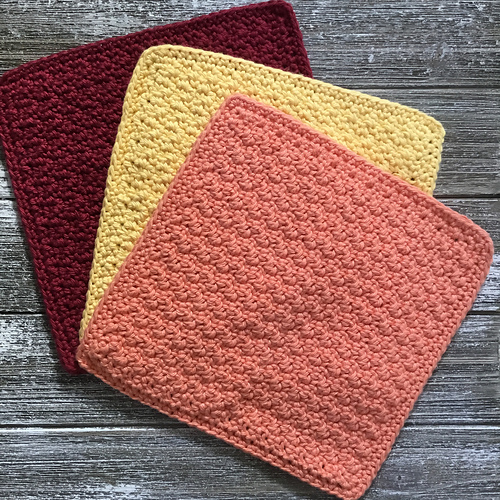
Find this pattern on HoneyBee
Catherine Richardson. Worsted weight, 5mm hook. Single-crochet dishcloth with a small textured pattern. The whole project uses one skein of acrylic or cotton, finishes in a single evening, and gives you stitch-identification practice on a flat, low-stakes piece. Pick a light gray or cream worsted acrylic at the store; use the entire skein on this and one or two more dishcloths before moving up to a bigger project. The dishcloths are functional kitchen items, so the finished objects don't go to waste even when they're not your best work.
Customizable Poncho (bulky confidence-builder)

Find this pattern on HoneyBee
Patti. Bulky weight, US K (6.5mm) hook. A simple rectangular poncho, sized to fit by adjusting the rectangle's dimensions. Bulky yarn means the project finishes in a weekend; the simple construction means there's nothing to fail at. After the dishcloths teach you stitch identification, this teaches you that you can finish wearable garments in a reasonable timeframe. Use a smooth solid bulky acrylic in a medium color; the four-spec rule applies the same way at bulky weight as at worsted.
Common beginner mistakes
Buying the yarn before picking the pattern. Patterns specify yarn weight and approximate yardage. Buying yarn first means either having to find a pattern that matches your yarn (limiting your options) or having yarn that doesn't fit any pattern you actually want to make. Pick the pattern, then buy the yarn.
Buying enough yarn for one skein when the pattern needs three. Yardage estimates are on the pattern. A worsted dishcloth uses 50 to 100 yards; a worsted scarf uses 300; a worsted afghan uses 1,500 to 2,500. Check the pattern's stated yardage and divide by the yards-per-skein on the label.
Buying one skein per color and hoping the dye lot matches. Yarn from different dye lots can be visibly different shades of the same color. If your project needs more than one skein of a color, buy all the skeins from the same dye lot at the same time; the dye-lot number is on the label.
Switching yarn brands mid-project. Two yarns labeled the same weight from different brands have different gauges, different drape, and different dye behavior. Don't substitute brands mid-project unless you've checked gauge on both.
Choosing a difficult color because it would look better. First-project navy will produce a worse navy project than first-project gray will produce as a gray project. The yarn that lets you see your stitches is the yarn that lets you make a good project. Sophistication can come later.
FAQ
Is acrylic actually fine for serious projects?
For garments that will see daily use and washing, acrylic is fine. The "real crocheters use natural fibers" position is mostly aesthetic preference, not a structural argument. Acrylic doesn't pill, doesn't shrink, washes in a machine, and lasts. The reasons to prefer wool or cotton are warmth (wool), breathability (cotton), and environmental impact, not durability.
What about second-hand yarn or stash inheritance?
Use it if it meets the four-spec rule (worsted weight, smooth, light solid color, not brittle from age). Test by pulling on a strand: if it stretches and recovers, it's fine. If it breaks easily, the yarn has degraded and isn't worth working with.
Do I need different yarn for amigurumi?
For first amigurumi, yes: drop down to sport weight and use a smaller hook than the yarn label suggests. Amigurumi needs a tight, dense fabric so the stuffing doesn't show through, which means working at a smaller-than-recommended gauge. Many amigurumi patterns specify worsted weight with a 3.5 or 4mm hook, half a millimeter to a millimeter smaller than the label's "recommended" size.
Can I learn on the yarn my grandmother gave me?
If it meets the four-spec rule, yes. Old yarn that's been stored well is fine; old yarn that's brittle, smells musty, or breaks under tension is not worth the frustration of working with. The age isn't the problem; the storage condition is.
What's wrong with cone yarn?
Nothing structurally. Cones save money per yard for high-volume projects. But cones don't have center-pulls, so the yarn unspools from the outside, which can roll the cone across the floor while you're crocheting. Cones also don't fit in most yarn bowls. For first projects, the ready-to-use skein is the better experience.
Related guides
- Yarn Weight Chart Explained
- How to Crochet for Beginners
- Crochet Supplies for Beginners
- How to Choose Your First Crochet Project
- How to Read a Crochet Pattern
For the yarn-weight classification this guide depends on, the Craft Yarn Council's yarn weight system is the canonical reference. The four-spec rule maps directly to label categories defined there.
Worsted, smooth, light solid color, cheap. The brand name on the label is the least important thing on the ball band.
More from the HoneyBee blog
Pattern round-ups, tutorials, and crafting inspiration from the HoneyBee community.
Read more articles