Yarn Weight Chart: All Eight Weights, What They're For, What to Skip
The Craft Yarn Council's 0 through 7 weight system, what each weight is structurally good at, the three weights you'll actually use, and why pattern speed is the wrong reason to pick a weight.
On this page25 sections▾
The Craft Yarn Council groups yarns into eight weight categories numbered 0 through 7, from cobweb-fine lace to ropey jumbo. The system is industry standard; every yarn label uses it, and every pattern's "recommended yarn weight" maps to a number on this chart.
Two important things the chart doesn't say outright. First, most knitters and crocheters use three of the eight weights for ninety percent of their projects: DK (3), worsted (4), and fingering (1). The other five exist for specific cases. Second, "faster projects" is not actually a useful reason to pick a weight, because picking a weight by speed alone produces fabrics that look wrong for what they're supposed to be. The right reason to pick a weight is what the finished fabric is supposed to do: drape, hold structure, lie flat, fit close, stay warm, stay light.
This guide goes through each weight, what it's structurally suited for, and the one example pattern that demonstrates the weight's natural use case.
The chart
| # | Category | Common names | Knit needle (US) | Knit gauge per 4" | Crochet hook (mm) |
|---|---|---|---|---|---|
| 0 | Lace | Cobweb, thread | 000 to 1 | 33 to 40 sts | 1.5 to 2.25 |
| 1 | Super fine | Fingering, sock | 1 to 3 | 27 to 32 sts | 2.25 to 3.5 |
| 2 | Fine | Sport, baby | 3 to 5 | 23 to 26 sts | 3.5 to 4.5 |
| 3 | Light | DK, light worsted | 5 to 7 | 21 to 24 sts | 4.5 to 5.5 |
| 4 | Medium | Worsted, aran | 7 to 9 | 16 to 20 sts | 5.5 to 6.5 |
| 5 | Bulky | Chunky, craft | 9 to 11 | 12 to 15 sts | 6.5 to 9 |
| 6 | Super bulky | Roving | 11 to 17 | 7 to 11 sts | 9 to 15 |
| 7 | Jumbo | Roving | 17+ | 6 sts and fewer | 15+ |
Weight 0: Lace
Cobweb-thin yarn. The gauge ranges from about 33 to 40 stitches per 4 inches in knit fabric, which is fine enough that pattern detail (yarn-overs, decreases, openwork structures) reads at a distance. The fabric blocks open into airy, near-transparent textile.
What lace is good at: traditional lace shawls, fine garments that show stitch pattern, anything where the openwork is the point. The blocking changes the fabric dramatically; an unblocked lace project looks half-finished. See the blocking guide for why this is non-negotiable.
What lace is bad at: warmth, structure, anything that has to hold a shape. Lace makes flexible drape, not warm or structured fabric.
Annis (knit lace shawl)

Find this pattern on HoneyBee
Susanna IC. Lace weight, US 5 circular. Crescent-shaped shawl with a body of garter stitch and a lace edge of nupps and yarn-overs. The yarn-overs scrunch closed during knitting and open up dramatically during blocking, which is the canonical "what lace weight is for" experience.
Weight 1: Super fine (fingering)
Sometimes called sock weight because socks are the most common use case, but fingering is a versatile workhorse weight. Stitch definition is sharp; the fabric is light but holds structure better than lace. Most lace shawls in commercial publication are actually fingering weight (technically weight 1), not lace weight, because fingering gives a balance of detail and durability that pure lace can't match.
What fingering is good at: socks, gloves, fitted accessories, lightweight pullovers, drapey shawls. Fingering is the weight where complex colorwork (Fair Isle, mosaic) lands; the stitches are small enough that intricate patterns read cleanly.
What fingering is bad at: bulky cold-weather warmth, fast-progress projects, beginner-friendliness. Fingering takes the most time per square inch of any weight.
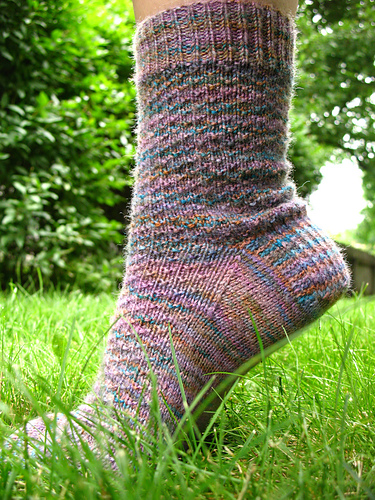
Hermione's Everyday Socks (knit fingering)
Find this pattern on HoneyBee
Erica Lueder. Fingering weight, US 1 dpns or magic loop. The default first-sock pattern: cuff down, simple textured pattern stitch, standard heel flap, no lace or cables to fight while learning sock construction. The pattern is widely used as a beginner's first sock because it's the cleanest fingering-weight first-sock written.
Weight 2: Fine (sport, baby)
Slightly thicker than fingering. Sometimes labeled "sport" or "baby," partly because soft sport-weight cottons and merinos are the traditional baby-garment yarn. The fabric is light but warmer than fingering, and it works up noticeably faster.
What sport is good at: baby garments, lightweight cardigans, summer-weight pullovers, fine-gauge accessories where fingering would feel too thin. Sport is also the right weight for a lot of traditional Nordic colorwork.
What sport is bad at: nothing terrible. Sport is a generally usable weight that ends up underused because DK does most of the same jobs slightly faster.
wurm (knit sport hat)

Find this pattern on HoneyBee
katushika. Sport weight, US 5 16-inch circular. Slouchy striped beanie, knit in the round with simple textured bumps. Sport weight gives this hat its thin, drapey hand; the same pattern in worsted would feel stiff and would sit differently on the head. The pattern is also a clean introduction to working in the round on small-circumference needles.
Weight 3: Light (DK, light worsted)
DK ("double knitting") is the second-most-used weight in modern publication. Lighter than worsted but heavier than sport; the fabric is fine enough for fitted garments but works up quickly enough that a sweater is plausible in a month rather than a season. The weight is dominant in British and European patterns; American publication leans worsted, but DK is gaining.
What DK is good at: fitted sweaters, cardigans, lightweight blankets, accessories that need to drape, almost any indoor garment. DK is the weight where most knitwear lives if you're not specifically looking for chunky or fine.
What DK is bad at: dramatic warmth, very-fast-progress projects.
The Age of Brass and Steam Kerchief (knit DK shawl)

The Age of Brass and Steam Kerchief
Find this pattern on HoneyBee
Orange Flower Yarn. DK weight, US 7 needles. Small triangular shoulder-cover with garter stripes and yarn-over increases at the center back. The garter texture is the right call for DK; the weight is light enough to drape but heavy enough that the fabric has body. One skein of DK gets you the whole kerchief in two evenings.
Weight 4: Medium (worsted, aran)
The default for North American publication. If you walk into a yarn store and grab a random skein labeled "wool," it's almost certainly worsted weight. Aran is slightly heavier than worsted but they're grouped together in the CYC system. Fabric is substantial enough to feel warm and structured; stitches are big enough to learn on; pattern selection is enormous.
What worsted is good at: sweaters, blankets, hats, mittens, almost everything. Worsted is the weight where "I want to make a thing" intersects with "I want to actually finish it" for most projects.
What worsted is bad at: nothing in particular. It's the default for a reason.
Flax worsted (knit worsted sweater)

Find this pattern on HoneyBee
tincanknits. Worsted weight, US 8 needles. Seamless top-down raglan in sizes from baby to adult XXL. The free version of the pattern available on the designer's site has been the default first-sweater for a decade. Worsted weight is what makes it work: stitches are large enough to be approachable for a first garment, the fabric is warm enough to be a real sweater, and the project completes in three to six weeks rather than three to six months.
Weight 5: Bulky (chunky)
Roughly twice the thickness of worsted by stitch gauge. Projects work up at four to five times worsted's pace because each stitch is bigger. Fabric is heavy, warm, and casual; stitches read at distance. Bulky is the weight for "I want this done by next week" projects and for cold-weather statement accessories.
What bulky is good at: quick blankets, statement cowls, thick winter hats, simple cardigans where the weight is the design point. Bulky finishes projects in days, not weeks.
What bulky is bad at: fitted garments (the fabric is too thick to fit closely), fine detail (the stitches are too big), summer wear.
GAP-tastic Cowl (knit bulky)

Find this pattern on HoneyBee
Jen Geigley. Bulky weight, US 13 16-inch circular. Wide infinity cowl in seed stitch, worked in the round, two skeins. Finishes in a single evening. This is one of the most-knit bulky patterns in modern publication because it captures everything bulky is good for: fast, warm, statement texture, and the kind of project that becomes a gift in the same weekend you cast on.
Weight 6: Super bulky (roving)
Even thicker than bulky. The stitch count drops to single digits per 4 inches in many cases; you can finish a hat in two hours and a cowl in one. The fabric is dramatic, somewhat stiff, and very warm. Super bulky is also where the chunky-Instagram-blanket aesthetic lives.
What super bulky is good at: very fast warm projects, dramatic accessories, decor pieces, anything where the bulk itself is the visual statement.
What super bulky is bad at: fitted anything, garments that need to drape, lightweight wear.
Iced (knit super-bulky cardigan)

Find this pattern on HoneyBee
Carol Feller. Super-bulky weight, US 15 needles. Seamless raglan cardigan, top-down, garter-texture body. Super-bulky is what makes the cardigan finish in two weeks instead of two months, and the heavy fabric is the design point: this isn't a fitted cardigan, it's a slouchy outer layer. The super-bulky weight is the entire reason this pattern works as a "first cardigan" for many knitters.
Weight 7: Jumbo
The largest standard category, used for arm knitting, chunky decor blankets, and accessories where the yarn itself is the design. Stitch counts are tiny (the gauge column on the chart says 6 stitches per 4 inches and fewer). Projects are very fast but use a lot of yarn by weight, which makes jumbo expensive per project.
What jumbo is good at: oversized blankets and throws as decor, statement floor cushions, arm-knit projects, pieces where the yarn's bulk is the entire visual.
What jumbo is bad at: clothing (almost never works at human scale), anything that needs structure (jumbo stitches stretch dramatically under their own weight), detailed pattern work.
Beautyberry Blanket (knit jumbo blanket)

Find this pattern on HoneyBee
Purl Soho. Jumbo weight, US 50 needles. Garter-stitch throw blanket in undyed roving. The needles are oversized broomsticks (US 50 is roughly 25mm in diameter); the stitches are inches across. The blanket finishes in a long afternoon, uses several pounds of yarn, and reads as a sculptural object as much as a textile. This is what jumbo is for.
How to actually pick a weight
Ignore the speed argument. Picking a weight by "how fast" produces projects that look wrong for what they're meant to do. The structural argument is:
The finished fabric has a job to do. A sweater needs to be warm and to drape over a body. A summer top needs to be light and breathable. A blanket needs to be heavy enough to feel like a blanket but not so heavy it slides off the couch. The weight you pick is the one that gives the finished fabric the hand you want.
The pattern says what weight it was designed for. Use that weight. Substituting a different weight changes the fabric character, the finished dimensions, and often the project's success. Patterns are designed around the weight they specify.
Three weights cover most projects. Worsted for default garments and blankets. DK for fitted garments where worsted is too heavy. Fingering for socks, gloves, and detailed colorwork. Add bulky if you want one fast project per year. The other four weights are for specific cases that mostly don't come up.
FAQ
Are weight 3 and weight 4 interchangeable?
Not really. DK (3) and worsted (4) are close in thickness but not identical. A worsted pattern knit in DK comes out smaller, lighter, and drapier; a DK pattern knit in worsted comes out larger and stiffer. The substitution is sometimes done deliberately as a design choice (a worsted pattern in DK for a lighter-weight version), but never by accident.
Why do two yarns of the same weight have different yardage per 100g?
Fiber density. Wool is denser than acrylic; alpaca is denser than cotton; silk is denser than mohair. Two skeins labeled "worsted weight, 100 grams" can have yardages ranging from 180 to 220 yards depending on what fiber is inside. Read the label, not just the weight number.
What's the difference between aran and worsted?
Aran is slightly heavier than worsted. Both fall in CYC category 4. The aran-worsted distinction is mainly British/Irish vs American naming for the same general weight range, with aran skewing slightly thicker. For most patterns, the two are interchangeable.
Can I substitute lace weight for fingering?
Sometimes, by holding the lace yarn double. Two strands of lace held together give roughly fingering-weight fabric. The math doesn't always work perfectly (the doubled yarn is a hair thinner than true fingering), and the patterns read differently in two-color held-double versions, but it's a viable substitution.
What's "any-gauge" yarn?
Yarn that's been spun to work across multiple weight categories depending on needle size and the look you want. The label gives suggested needle sizes for different gauges. Useful for designers who want their pattern to be flexible; sometimes confusing for beginners who want a single answer.
Related guides
- What Is Gauge in Knitting and Crochet
- Knitting Supplies for Beginners
- Crochet Supplies for Beginners
- How to Choose Your First Knitting Project
- How to Choose Your First Crochet Project
For the canonical reference, the Craft Yarn Council's yarn weight system is the source these labels reference. Every yarn brand uses the CYC numbering; the council's page is what to send anyone arguing about whether a yarn is sport or DK.
Worsted, DK, fingering. The other five weights are for specific cases.
More from the HoneyBee blog
Pattern round-ups, tutorials, and crafting inspiration from the HoneyBee community.
Read more articles