How to Choose Your First Knitting Project: Six Patterns That Actually Work
How to pick a first knitting project you'll finish, what to look for past the difficulty label, and six specific patterns that earn their reputation.
On this page20 sections▾
You can cast on, knit, purl, and bind off. That is enough technique to make every project in this guide. The bigger question is which one. Pattern catalogs are huge, "beginner" is an inconsistent label, and the wrong first project (too long, too fiddly, requires a technique you don't know yet) is the most common reason new knitters quit before they finish anything.
This guide covers how to evaluate a pattern past its difficulty tag, then names six specific patterns that work as a first project because of their structure, not their marketing.
How to evaluate a pattern before you start
Read the technique list, not the label
"Beginner" can mean "knit and purl only" or it can mean "uses short rows, M1L/M1R increases, and a tubular bind-off." Open the pattern, scroll past the cover photo, and read the abbreviations and notes sections. If any technique looks unfamiliar, the pattern is over your current level even if the difficulty badge says beginner.
A true beginner pattern uses some subset of: cast-on (long-tail or knitted), knit, purl, knit-2-together, yarn over, bind off. That's it. Anything past that list adds learning overhead that compounds with the project's own difficulty.
Triple the time estimate
A pattern that says "8 hours" will take a first-time knitter 24-32. You'll re-read rows, recount stitches, tink (undo one stitch at a time), and occasionally frog (rip back) entire sections. This is normal. Plan for it.
For a first project, look for an estimate around 8-15 hours so the real time stays under 50. A 30-hour estimate becomes 90 hours of real time, which is the wrong scope for project one.
Yarn weight: worsted or aran
Worsted (medium, #4) is the right learning weight. The stitches are big enough to read, the fabric is dense enough to feel finished, and almost every beginner pattern is written for it. Aran is fine too; it's slightly thicker and works up a hair faster.
Below DK and you're fighting visibility. Above bulky and you're hiding tension issues that come back later when you switch back to worsted.
Pick wool or a wool blend over acrylic for the first project. Wool blocks (the wash-and-dry-flat finishing step) into a crisper finished fabric, which hides the small tension inconsistencies that every first project has. Acrylic doesn't bloom; whatever your tension looks like off the needle is what it looks like forever.
Match the project type to your life
Knitting projects fall into rough categories with different shapes of commitment:
Scarves and dishcloths. One stitch repeated. Set down and pick up anytime. Long finish line on a scarf, short one on a dishcloth.
Cowls and hats. Short. Introduce working in the round, which unlocks half of knitting. Defined finish.
Baby blankets. Bigger commitment than a scarf but the rectangular shape and simple stitch pattern stay forgiving.
Garments. Higher stakes. Require gauge swatching, fitting, and (sometimes) seaming. Save until you've finished at least two smaller projects.
The right first project matches both how much time you have per session and what you actually want at the end. If you want something you'll wear, a cowl is a better first project than a dishcloth even though dishcloths are slightly faster.
Six patterns that earn their reputation
One Row Handspun Scarf

Find this pattern on HoneyBee
Stephanie Pearl-McPhee. Worsted weight, US 8 needles. Garter stitch with a single slip-stitch variation on each row, which adds visual texture without adding any actually new technique. Reversible. Cast on 25 stitches with long-tail, work the one-row pattern until it's about 60 inches long, bind off. About 20-30 hours. This is the canonical first-knitter scarf for a reason: the one-row repeat is interesting enough to keep you engaged but simple enough that you can fix any mistake by tinking back a few stitches.
Ballband Dishcloth
Find this pattern on HoneyBee
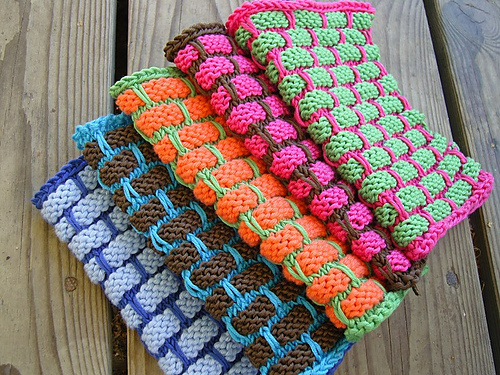
Kay Gardiner and Ann Shayne. Aran weight cotton, US 6 needles. A slipped-stitch colorwork pattern that produces a two-color woven look without holding two yarns at once (you slip the stitches from the previous row's color, which is easier than fair-isle stranded colorwork). 4-6 hours per dishcloth. Make one to learn the slipped-stitch mechanic, then make four more to use them or gift them. This is the right first project if you want to finish something this week.
Honey Cowl

Find this pattern on HoneyBee
Antonia Shankland. DK weight, US 6 16-inch circular. Worked in the round (no seaming) with a one-row slip-stitch pattern that builds a dense honeycomb fabric. The small (one-skein, 250-yard) size is the right scope for a first in-the-round project: long enough to settle into the pattern, short enough to finish in 15-20 hours. The slip-stitch fabric is forgiving of tension inconsistencies, which is exactly what you want when you're also learning the join.
Barley worsted

Find this pattern on HoneyBee
tincanknits. Worsted weight, US 7 and US 8 needles. The reference first hat: ribbed cuff, stockinette body, simple decreases at the crown. Available in sizes from baby to adult, all in one PDF. 10-15 hours for an adult size. The pattern's accompanying photo tutorial is the calibration point for "how to write a beginner pattern"; bookmark it. After Barley you'll have made every move that every basic hat requires.
Sunny Baby Blanket

Find this pattern on HoneyBee
Lucie Sinkler. Worsted weight, US 8 needles. A textured rectangular blanket built from knit and purl combinations that create a quilted look without any actual quilting. 35-45 hours. The stitch pattern repeats every four rows, so you settle in quickly and can knit large stretches without consulting the pattern. Pick this over a stockinette baby blanket if you want something more interesting to make; pick a plain garter blanket instead if you'd rather have the lowest possible cognitive load.
Flax worsted

Find this pattern on HoneyBee
tincanknits. Worsted weight, US 8 needles. The reference first sweater. Top-down raglan construction (no seaming, you try it on as you go), garter-stitch sleeve panels for visual interest, sizing from newborn to 4XL. 40-60 hours. Don't make this your first project; make your fourth, after a scarf, a cowl, and a hat. The pattern has the cleanest written instructions in the genre, and the tincanknits photo tutorial walks every step. By the time you finish Flax you've made every move a top-down sweater needs.
Which one to start with
If you want a fast result and aren't sure you're going to like knitting yet, Ballband Dishcloth. It's done in a weekend and uses a technique that transfers to bigger projects.
If you want a scarf you'll actually wear and the time to make it, One Row Handspun Scarf. It's the standard first-knitter scarf.
If you've finished any flat project and want to learn the round, Honey Cowl. It teaches the join with no other new techniques layered on top.
Skip Sunny Baby Blanket and Flax until you have at least one of the smaller projects behind you. The blanket is a stamina test; the sweater is a multi-technique test. Both are easier when they're not also your introduction to the basic mechanics.
FAQ
Should I swatch?
For the scarf, dishcloth, and blanket, skip it. The finished size won't matter if it's off by an inch. For the cowl, hat, and sweater, swatch. Knit a 4-inch square in the pattern's stitch and yarn. Wash and dry it the way you'll wash and dry the finished project. Then measure. If your gauge doesn't match the pattern's, change needle size (up if you have too many stitches per inch, down if too few) and swatch again. A 20-minute swatch saves a 50-hour mistake.
How much yarn do I need?
The pattern lists it in yards or grams. Buy 10-15% more than the pattern says. The 10-15% buffer covers a mid-project miscount that requires extra rows, plus the inevitable swatch yarn, plus weaving in ends. Yarn is expensive enough that running out 90% through is the wrong way to discover you underestimated.
What if I drop a stitch?
It's recoverable. A dropped stitch in stockinette runs down the fabric like a snag; pick it up with a crochet hook by pulling each ladder rung through. A dropped stitch in garter is harder to recover and usually means tinking back to the dropped row. For a first project, mark up your needles every 10 rows so you can rip back to a known good row if a mistake is unfixable.
Can I substitute the yarn?
Within the same weight category, yes. Worsted for worsted, DK for DK. Across categories, no, unless the pattern explicitly says it's gauge-flexible. The cowl and hat care about gauge because the fit depends on it; the scarf and dishcloth don't care.
Which counts as my first "real" project?
Whatever you finish. The scarf, the dishcloth, the cowl, the hat, all count. Stop ranking finished projects against each other and move to the next one. The progression from project one to project ten matters more than what project one was.
Related guides
- How to Knit for Beginners
- How to Read a Knitting Pattern
- Knitting Supplies for Beginners
- How to Cast On in Knitting
- How to Knit in the Round on Circular Needles
For yarn weight conventions when you start substituting, the Craft Yarn Council's yarn weight system is the universal reference.
Pick one pattern. Read it start to finish before buying yarn. Then buy the yarn.
More from the HoneyBee blog
Pattern round-ups, tutorials, and crafting inspiration from the HoneyBee community.
Read more articles