
How to Knit in the Round on Circular Needles
How to pick the right circular needle length, cast on, join the round without a twist, and avoid the loose-join ladder that ruins beginner hats.
On this page15 sections▾
Hats, cowls, socks, and most modern sweaters are knit as tubes on circular needles instead of as flat pieces that get seamed together. The advantage isn't speed; it's that the resulting fabric has no seam, fits more comfortably, and is harder to ruin in the finishing stage because there's no finishing stage to ruin.
The trade is one moment of fiddly setup: casting on, making sure the row isn't twisted, and joining the ends into a continuous round without leaving a visible gap at the seam. Past that first round, knitting in the round is the same as knitting flat, minus the purl rows.
This guide covers needle selection, the cast-on, the join, the gap problem, and the magic loop alternative for small-circumference projects.
Picking the right circular needle
A circular needle is two needle tips connected by a flexible cable. The relevant measurement is the total length (tip to tip including the cable), which determines what size of tube you can knit.
The needle should be a few inches shorter than the project's finished circumference. A 20-inch hat brim on a 24-inch needle, or a 36-inch sweater body on a 32-inch needle. If the needle is longer than the project, your stitches won't reach around the cable; if it's much shorter, they bunch up. Both are uncomfortable to knit.
The common lengths and what they're for:
| Length | What it fits |
|---|---|
| 9 inch | Small sock cuffs, mittens, very small hats |
| 16 inch | Adult hats, baby sweater yokes, cowls |
| 24 inch | Loose hats, sleeves, small children's sweaters |
| 32 inch | Adult sweater bodies, throws |
| 40 inch or longer | Magic loop on small projects, large blankets |
If you can buy only one, get a 16-inch in US 6 or US 8 (5mm or 4mm). It covers most hats and cowls, the two projects beginners actually make in the round.
Material matters less than length. Bamboo grips yarn and is forgiving; metal is slick and fast. Try both. The cable matters more than people expect: stiff cables coil and fight you, supple ones lay flat. ChiaoGoo and Addi cables are the two reference points for "supple"; cheaper sets often kink.
Casting on for circular knitting
Use any standard cast-on (long-tail is fine, cable is fine). Cast directly onto the circular needle as if it were a straight needle. The cable just hangs to the side. You're casting onto one of the needle tips and letting the new stitches slide onto the cable as the row grows.
When you finish the cast-on, slide the stitches around the cable so they're evenly distributed and the working yarn is on the right-hand needle tip.
The join: the part that goes wrong
This is the moment that turns the flat cast-on row into a tube. Two things have to be true at this moment:
- The cast-on row is not twisted. Every stitch should hang the same direction off the needle and cable. The simplest check: lay the work flat on a table with the needle tips toward you. The bottom edge (the bumpy edge of the cast-on) should form an unbroken line around the inside of the needle. If any part of it crosses over the cable, you have a twist.
- You can identify the first stitch you cast on (the one closest to the left needle tip, opposite the working yarn). This is the stitch you'll knit first.
To join:
- Confirm no twist. Look at the cast-on edge all the way around. Adjust until every stitch hangs the same way.
- Hold the needle in both hands as if to start a row of flat knitting.
- Knit the first stitch of the cast-on with the working yarn. That stitch is now joined to the end of the cast-on row.
- Continue knitting around. Place a stitch marker on the right needle to mark the start of the round so you know when you've come back to the beginning.
A twist caught on round 2 means ripping out the whole project. A twist caught after the first stitch is also unfixable. Spend the 20 seconds to look before joining.
The gap problem
The first stitch of round 1 always feels loose, and a small visible ladder runs up the work at the join. This is universal, not a sign of poor technique.
The two fixes, used in combination:
- Knit the first stitch firmly, with extra tension on the working yarn. This pulls the join tight.
- Swap the order of the first two stitches of round 2. Slip the first stitch of the round from the left needle to the right without working it. Then knit the rest of the round. When you reach the end, you'll have an extra stitch on the right side; lift the slipped stitch over the next stitch to keep your stitch count correct. This trick redistributes the slack and hides the ladder.
Most knitters don't bother with the swap; the small ladder is hidden inside the join column and isn't visible from the outside. Worth knowing about for ribbed cuffs where the ladder would interrupt the pattern.
When 16 inches is too long: the magic loop
For sock cuffs, mitten tops, and the crowns of hats (anywhere the circumference shrinks below ~16 inches), 16-inch needles stop working: the stitches don't reach around the cable.
The traditional solution is double-pointed needles (DPNs), four or five short needles arranged in a square. They work but are awkward to learn. The modern alternative is magic loop, which uses a single very long circular needle (40 or 47 inches) instead.
How magic loop works:
- Knit on a long circular as normal up to the point where the project gets too small for the cable.
- Pull a loop of cable out between two stitches at the back of the work, splitting your stitches roughly in half: half on one needle tip, half on the other.
- Push the front-half stitches onto their needle tip. Pull the back-half cable out toward you.
- Knit across the front half with the back tip. When done, rotate, slide stitches around, repeat.
The motion takes a project or two to feel natural. Once it does, magic loop replaces DPNs entirely for most knitters. One long circular handles everything from a sock cuff to a sweater body; you stop carrying multiple needle sets around.
Three projects to learn on, in order
Hat after cowl after the first scarf is the standard progression. If you've already finished a flat scarf, a cowl is the right next step (introduces the join and the in-the-round mechanic with no decreases to manage). A hat is the step after that (introduces crown decreases, which is where DPNs or magic loop become necessary).
Honey Cowl

Find this pattern on HoneyBee
Antonia Shankland. DK weight, US 6 needles, 16-inch circular. The pattern uses a one-row slip-stitch repeat that creates a thick honeycomb fabric, and the whole project is the tube portion of in-the-round knitting with no decreases or shaping at the end. That means the only new technique to learn is the join. Comes in four sizes; the small (250-yard, one-skein) version is the right scope for a first attempt.
Classic Ribbed Hat

Find this pattern on HoneyBee
Purl Soho. DK weight, US 6 16-inch circular, plus DPNs or a longer circular for magic loop at the crown. The hat is twisted-rib all the way up with a slight crown decrease at the end. If you've made the Honey Cowl, this is the next step: same construction, same yarn weight, plus the transition from circular to DPNs at the crown that you'll use on every future hat.
Hermione's Everyday Socks
Find this pattern on HoneyBee
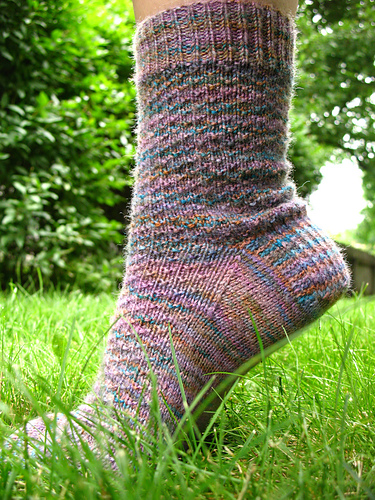
Erica Lueder. Fingering weight, US 1 needles. Top-down with a small four-row stitch pattern that's much more interesting to knit than plain stockinette socks. This is the canonical first-pair-of-socks pattern; if you walk into any knitting circle and say "I just finished Hermione's," everyone has an opinion. Made in magic loop on a 40-inch circular, or on a set of US 1 DPNs.
FAQ
Can I use DPNs instead of a short circular?
Yes. DPNs and 9-inch circulars are interchangeable for small-circumference work. DPNs are cheaper to start with (one set replaces a needle for every circumference) and survive being dropped. Short circulars are faster once you've practiced. Most knitters end up owning both and switching based on the project.
How do I know if my stitches are twisted before joining?
Lay the cast-on row flat on a table, needles flat, and follow the bottom edge of the row around. The bumpy cast-on edge should sit inside the needle, with the smooth top of each stitch facing up. If the edge crosses itself anywhere, you have a twist. This is the only reliable check; visual inspection of the stitches alone misses subtle twists.
Why does my cowl pull tighter on one side?
The stitches on the cable bunch when you stop knitting, which creates uneven tension when you start again. After a break, slide the stitches around the cable to redistribute them before knitting the next round.
Do I need a separate circular needle for every size?
Long-term, an interchangeable set (tips that screw onto a shared cable system) replaces a dozen fixed circulars. Don't buy one for your first project. Buy one fixed 16-inch in the size your first pattern calls for, finish that project, and then decide whether you want to commit to a set ($100-200) or keep adding individual needles ($10-15 each).
Related guides
- How to Knit for Beginners
- How to Cast On in Knitting
- How to Read a Knitting Pattern
- Knitting Supplies for Beginners
- How to Crochet in the Round
For yarn weight standards and the needle sizes that go with each, the Craft Yarn Council's yarn weight system is the universal reference.
Knit a cowl in DK on a 16-inch. Then a hat in the same weight on the same needle, with the crown finished in magic loop. After two projects, the join stops feeling like the hard part.
More from the HoneyBee blog
Pattern round-ups, tutorials, and crafting inspiration from the HoneyBee community.
Read more articles