What Is Gauge in Knitting and Crochet, and When Does It Matter?
What gauge is, how to measure it, why a 10% miss on a sweater is a disaster and on a blanket is nothing, and what to actually do when your swatch doesn't match.
On this page16 sections▾
Gauge is the number of stitches and rows that fit into a four-inch (or 10 cm) square of finished fabric. That's the whole definition. The complication isn't what gauge is; it's deciding when to care about it and what to do when your gauge doesn't match the pattern's.
Short version: for fitted items (sweaters, hats, socks, gloves), gauge is non-negotiable, and the 20 minutes spent swatching saves the 50 hours spent making something that doesn't fit. For rectangles without a target size (scarves, dishcloths, blankets), gauge mostly doesn't matter, and you can skip the swatch.
This guide covers the math behind why a small gauge miss becomes a big size problem, how to measure correctly, what to do when you're off, and which projects let you skip the swatch entirely.
How a 10% miss compounds
A pattern reads "18 stitches and 24 rows = 4 inches in stockinette." That's 4.5 stitches per inch horizontally and 6 rows per inch vertically.
If your gauge measures 16 stitches per 4 inches instead of 18, you're at 4 stitches per inch instead of 4.5. The percentage difference is about 11%.
For a 36-inch sweater chest, the pattern calculates 162 stitches (36 × 4.5). At your gauge, those 162 stitches produce 40.5 inches (162 ÷ 4). Your sweater is 4.5 inches bigger than intended.
That's a difference of one full size class. The hat sits on your eyebrows. The sock heel hits your arch. The sweater cuff lands at your knuckle. None of these is salvageable without ripping back and redoing.
The same 11% miss on a 60-inch blanket is 6.6 inches. The blanket is now 66 inches. Nobody notices. Nobody complains.
This is why gauge matters in some projects and not others. The fix isn't to be a better knitter; it's to know which projects you have to swatch for.
When to swatch
Always swatch:
- Sweaters, cardigans, vests
- Fitted hats (anything other than a slouchy beanie)
- Socks
- Gloves and mittens
- Anything that wraps around a body part with a specific circumference
Don't bother swatching:
- Scarves and shawls without a stated final width
- Dishcloths and washcloths
- Throw blankets without a target dimension
- Amigurumi (the fabric tightness matters more than the gauge number, and you can adjust hook size by feel as you start)
Judgment call:
- Cowls (matter if they need to fit over a head, less if they're meant to drape loose)
- Baby blankets with a stated final dimension (a baby blanket that's 4 inches off still works, but if you wanted exactly 30x36 inches because of a quilt frame or a specific intended use, swatch)
How to read the gauge in a pattern
Gauge appears in the pattern's materials section. It looks like one of these:
- "20 sts and 28 rows = 4 inches in stockinette on US 6 needles"
- "16 sts and 18 rows = 4 inches in single crochet using a 5mm hook"
- "5 sts per inch on 4mm needles in stocking stitch"
The three pieces of information matter equally:
- Stitches per 4 inches (or per inch). The horizontal count.
- Rows per 4 inches. The vertical count. Less critical than the stitch count for most projects.
- The stitch pattern. Stockinette, single crochet, ribbing, lace, mosaic; the gauge changes with the stitch. Measure in the same stitch the pattern specifies, even if the project has different stitches in cuffs or borders.
If the pattern lists gauge after blocking ("gauge measured after blocking"), measure your swatch after washing and drying it the same way you'd treat the finished project. Wool blooms noticeably during blocking, so your unblocked gauge can be off by 10% from your blocked gauge.
How to swatch
- Cast on (or chain) more stitches than the pattern's gauge calls for. For "20 sts = 4 inches" use 30 stitches; the extra ten give you something to measure away from the edges.
- Work in the pattern's stitch for at least 6 inches of height. Long enough to measure rows accurately past the edge distortion.
- Bind off (or fasten off). A swatch under tension on a needle measures differently from a relaxed one.
- Wash and block it if the pattern's gauge is post-block. Lay flat to dry; don't stretch.
- Lay it on a flat surface without pulling. Place a ruler horizontally near the middle of the swatch. Count how many stitches fit in 4 inches (or 1 inch and multiply). Place the ruler vertically and count rows the same way.
Measure twice in different parts of the swatch and average. Tension drift is real; the count near the cast-on edge is often different from the count higher up.
What to do when your gauge is off
The two practical fixes:
More stitches per inch than the pattern calls for. Your tension is tighter, or your needle is smaller than the pattern assumes. Go up one needle size (or one hook size) and re-swatch. Repeat until you match.
Fewer stitches per inch than the pattern calls for. Your tension is looser, or your needle is bigger than the pattern assumes. Go down a needle size and re-swatch.
If you can't match within two needle-size changes, your yarn is the wrong weight for the pattern. Substitute a different yarn. Don't try to grind your tension into matching gauge by force; tension reverts to normal after a few rows and the project will go off-spec mid-knit.
Row gauge is harder to fix than stitch gauge. Most knitters and crocheters get stitch gauge right and row gauge slightly off. For patterns measured in rows (most colorwork, most knitted-flat sweaters), accept the row mismatch and adjust length by inches rather than rows. For patterns measured in inches with row counts as guidance, ignore the row count entirely.
What to do when you don't want to swatch
For unfitted projects (scarves, washcloths, blankets), skip the swatch and start the project. Knit (or crochet) the first 4-6 inches in the project's pattern, then measure. If the gauge is wildly off and you care about the finished dimensions, rip back and change needle size. If it's close, keep going.
This works because the first 4-6 inches of the project ARE a swatch; you've just chosen not to wash and bind off the swatch separately. Treat the start of the project as the gauge check.
A small project to practice gauge on
The fastest way to internalize gauge is to make a dishcloth, measure your gauge against the pattern, and see how much variance there is between you and the designer's tension. If you're new to swatching, treat one of these as your practice piece.
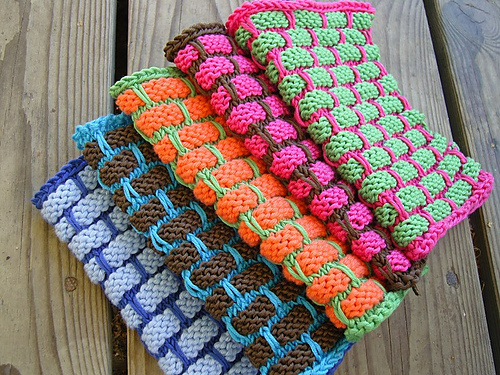
Ballband Dishcloth (knit)
Find this pattern on HoneyBee
Kay Gardiner and Ann Shayne. Aran weight cotton, US 6 needles. Cotton dishcloth in slipped-stitch colorwork; the finished size doesn't matter, but you'll see exactly how your tension compares to the designer's gauge spec over a project small enough to finish in an evening. Make one in the called-for needle size; then if your gauge was tight, make a second with one size up. The two side-by-side teach the relationship between needle size and finished fabric better than any chart.
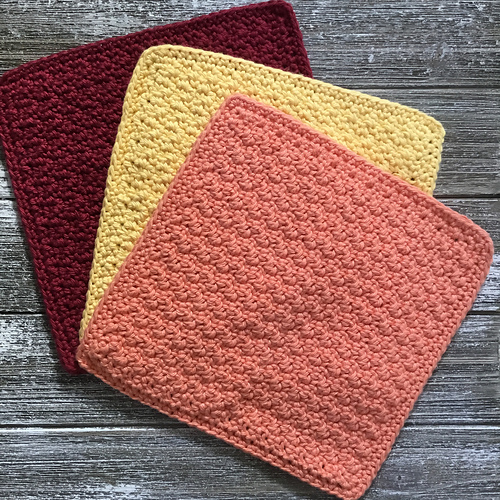
Spread the Dishcloth Joy (crochet)
Find this pattern on HoneyBee
Catherine Richardson. Worsted weight, 5mm hook. Single-crochet base with a small repeat. Same idea: small enough to be a practice swatch in disguise, big enough to teach you how your tension reads against the pattern's gauge spec.
FAQ
Can I check gauge without making a swatch?
For unfitted projects, yes; treat the first inches of the actual project as the gauge check. For fitted items, no. A swatch tells you whether your gauge is wrong before you've committed 50 hours.
What if my row gauge matches but stitch gauge doesn't?
Adjust needle or hook size to match stitch gauge first; row gauge usually falls in line. If it doesn't, accept the row mismatch and adjust the project length by inches rather than rows.
Do I need to wash my swatch?
If the pattern says "gauge after blocking," yes. Wool especially can change dimensions noticeably during the first wash. Cotton can shrink. Acrylic mostly doesn't move. When in doubt, wash; the only cost is twenty minutes and being unable to use the swatch as a coaster.
What does "ignore gauge" really mean?
It means the project will turn out at whatever size your tension produces, and that's fine for the project type. A garter scarf at 4.5 stitches per inch vs 4.0 stitches per inch is a slightly wider scarf with slightly different drape. No one will notice.
My swatch's gauge changes after washing. Which one do I use?
Whichever the pattern specifies. Most modern patterns ask for after-blocking gauge because that's the dimensional state the finished project will be in.
Related guides
- How to Read a Knitting Pattern
- How to Read a Crochet Pattern
- Knitting Supplies for Beginners
- Crochet Supplies for Beginners
- How to Choose Your First Knitting Project
For yarn weight conventions and the gauge ranges each weight is built around, the Craft Yarn Council's yarn weight system is the universal reference.
Swatch fitted things. Skip the swatch on scarves and blankets. Repeat as needed.
More from the HoneyBee blog
Pattern round-ups, tutorials, and crafting inspiration from the HoneyBee community.
Read more articles