
How to Increase and Decrease in Crochet
Increases and decreases are one operation each: add a stitch by working two into one, remove a stitch by combining two into one. Here's how to do them invisibly, where to place them, and which decrease method to pick for which stitch.
On this page21 sections▾
Shaping in crochet is two operations. An increase makes one stitch into two (work the stitch twice in the same base stitch). A decrease combines two stitches into one (start a stitch in the next base stitch, leave the last loop on the hook, start another, then close them together). Everything else, the entire taxonomy of "sc2tog" and "invisible decrease" and "dc inc," is variants of these two moves.
This guide covers both, plus the placement rules that decide whether the shaping reads as a clean curve or as visible lumps on the public side of the fabric.
Increases
The standard increase is to crochet two stitches into the same base stitch. That's the whole technique.
For a single crochet increase, you single-crochet into a base stitch as normal, then single-crochet into the same base stitch again. Stitch count goes from one to two; the row count stays the same. Repeat at the next increase point.
The same rule applies for double crochet, half double, treble, and every other stitch: two of them in the same base. The increase produces a small fan or splay on the public side because two stitches share one root, and that splay is the visual signature of an increase.
Where to place increases
The placement is what makes the shaping work.
Evenly distributed. If a pattern says "increase 6 stitches evenly around" on a 24-stitch round, that's an increase every 4 stitches. The increases sit at the corners of a hexagonal pattern, and the fabric grows as a flat disc (the hat-crown geometry). Bunching the increases all at one point would produce a wedge, not a disc.
Stacked on the previous round. If round 4 increased at position 7, 12, 17, 22, etc., and round 5 also increases at those same positions, you get clean radial spokes. The increases stack vertically and the disc has visible "seams" where the spokes are. Some designs lean into this look (the spiral of a granny-disk pattern); others stagger increases on alternating rounds so the spokes break up and the fabric reads smoother.
At the edge for flat shaping. If you're widening a piece worked flat (a sleeve cuff growing into the body of a sweater), increase at the start and end of every nth row. The shaping pulls the rectangle into a trapezoid. For a typical worsted-weight sweater, "increase 1 stitch each end every 4 rows" is a standard rate.
Invisible increase
The "invisible increase" is mostly an amigurumi convention. Instead of working two complete stitches into the same base, you work the first leg of a single crochet into the front loop, then the second leg into the back loop of the same base stitch. The result is one stitch that takes up two stitch positions, which functions as an increase without the splay. Read about it once and try it on a swatch; for most beginners, the standard 2-into-1 increase is fine and the invisible version is a refinement for later.
Decreases
Three common decrease methods. Pick the one whose stitch height matches the stitch you're already working in.
Single crochet decrease (sc2tog)
The most common decrease. Used in single-crochet fabric.
- Insert the hook into the next base stitch. Yarn over and pull up a loop. You now have two loops on the hook.
- Insert the hook into the following base stitch. Yarn over and pull up a loop. You now have three loops on the hook.
- Yarn over and pull through all three loops at once.
Two base stitches are consumed; one stitch on the hook is produced. Net result: stitch count drops by one.
Half double crochet decrease (hdc2tog)
For half-double fabric.
- Yarn over. Insert the hook into the next base stitch. Yarn over and pull up a loop. You have three loops on the hook.
- Yarn over. Insert the hook into the following base stitch. Yarn over and pull up a loop. You have five loops on the hook.
- Yarn over and pull through all five loops.
Double crochet decrease (dc2tog)
For double-crochet fabric.
- Yarn over. Insert the hook into the next base stitch. Yarn over and pull up a loop. Yarn over and pull through two loops. Two loops remain on the hook (an unfinished double crochet).
- Yarn over. Insert the hook into the next base stitch. Yarn over and pull up a loop. Yarn over and pull through two loops. Three loops remain on the hook.
- Yarn over and pull through all three loops.
Same logic as the others: two base stitches consumed, one stitch produced, with the working stitch's typical height.
Which decrease to pick
Match the decrease to the stitch you're working in. Single crochet fabric uses sc2tog; double crochet fabric uses dc2tog; half double fabric uses hdc2tog. Mixing decrease heights into a uniform-stitch fabric produces a visible texture break.
The exception is when a pattern deliberately uses a shorter decrease as a design feature (an sc2tog inside a dc fabric to create a small dimple), in which case the pattern will say so explicitly.
Invisible decrease (amigurumi)
The "invisible decrease" replaces sc2tog with a move that uses only the front loops of the two consumed stitches. It eliminates the small bump that sc2tog produces on the public side, which matters when the decrease is on the visible surface of a stuffed amigurumi figure. The mechanics:
- Insert the hook into the front loop only of the next stitch. Insert into the front loop only of the following stitch. Two loops on the hook now sit at the same level.
- Yarn over and pull through both loops.
- Yarn over and pull through the remaining two loops.
The result is a decrease that lies flat instead of leaving a small bump. For amigurumi heads, where the decreases close the top of a sphere and would otherwise be visible at the crown, this is the standard technique. For flat or garment fabric, the visible bump of a regular sc2tog usually doesn't matter and the simpler technique is fine.
Crown shaping: increases and decreases in one project
The classic exercise that uses both moves is a round-crown hat: start at the center with six stitches, increase to widen into a flat disc, work straight rows to form the side wall, decrease to close the crown back down. The same hat teaches every shaping principle.
The geometry: each round of all-increases produces a flat disc, each round of no-increases keeps the diameter constant, and each round of all-decreases narrows the work. A typical worsted-weight hat is roughly five rounds of increases (going from 6 to 60 stitches at 12 increases per round), eight to twelve rounds straight to build the side wall, then about five rounds of decreases (mirroring the increase rounds) to close the crown. Make one; the math will be clear in your hands.
Simple Double Crochet Hat

Find this pattern on HoneyBee
Rhondda Mol of Oombawka Design. Aran weight, I/9 (5.5mm) hook. Plain double-crochet beanie, written in sizes from preemie to adult. The construction is the canonical crown sequence: magic ring with eleven double crochets, then evenly-distributed increases for the next two rounds until the crown is the right diameter, then straight double crochets for the side wall, then a knit-2-purl-2-style brim. No decreases at the top because the crown closes from the brim end on this construction. The teaching value is in the increase math: you'll see exactly how 11 increases per round on the first three rounds produces a flat disc, and you'll see in your hands what happens if you increase one round too few (a dome instead of a disc).
Sphere shaping: amigurumi
Amigurumi shaping uses the same two operations to produce closed three-dimensional shapes. A sphere is built like a hat-crown except the increases continue further (to widen the equator), then mirror-image decreases close the bottom. Most amigurumi heads, bodies, and limbs are variations of this shape.
The shaping rate is what determines the shape. Slower increases produce taller, more egg-like forms; faster increases produce flatter, more disc-like forms. Patterns specify the rate explicitly: "Round 4: 2 sc in next sc, 2 sc repeat to end" gives one increase every three stitches, which is a specific shape signature.
For amigurumi specifically, the invisible decrease is worth learning because the decreases happen on the visible exterior and a row of sc2tog bumps on the top of a doll's head reads as a defect.
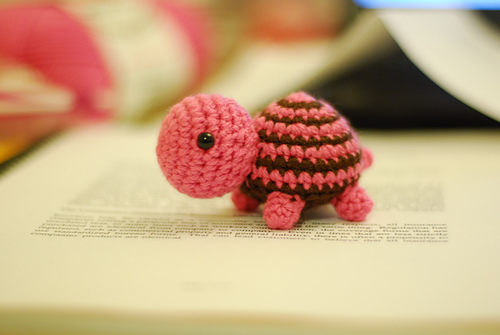
Tiny Striped Turtle
Find this pattern on HoneyBee
KristieMN. Worsted weight, small steel-or-aluminum hook for a tight stuffed-toy gauge. A palm-sized turtle in striped colors; the shell is built as a flat disc using the same increase math as a hat crown, the head is a small sphere using increase-and-decrease symmetry, and the legs are tubes worked straight. The teaching value is that the same two operations (increase = 2 in 1, decrease = 2 into 1) appear in three different applications inside one tiny project: flat disc, sphere, and tube. After a turtle, the shape vocabulary scales to any other amigurumi pattern you find. The striped color changes also give you weave-in-ends practice as a side benefit.
Common mistakes
Working an increase as one stitch with extra yarn. New crocheters sometimes try to "make a stitch bigger" by pulling extra yarn-overs through. That produces a longer stitch, not an additional stitch, and the count won't add up. The increase is always two complete stitches sharing one base.
Forgetting which base stitch is "the same one." When the increase is two stitches in one base, the second stitch goes back into the base of the just-completed stitch, not into the next base along. The first time you do this it feels wrong; trust the rule and check your stitch count at the end of the row.
Mixing decrease heights. Working sc2tog inside a double crochet fabric produces a step in the fabric height that doesn't smooth out. Match the decrease's working height to the surrounding stitch.
Not counting after each shaping row. A miscounted increase round is invisible during the row, then becomes obvious eight rows later when the piece is the wrong width. Counting is two seconds; redoing eight rows is twenty minutes. Always count.
Crochet decrease too tight. Yarn-over-and-pull-through-all-three on sc2tog tends to come out tight because three loops are denser than two. If the decrease is pulling, ease the working yarn before the final yarn-over.
FAQ
What does "evenly spaced" mean when a pattern says "increase 6 evenly around 24 stitches"?
It means the 6 increases should be roughly equidistant around the round. For 24 stitches with 6 increases, that's an increase every 4 stitches (4 + 1, 4 + 1, etc.). The general formula: divide the current stitch count by the number of increases to get the stitch interval, and place an increase at every interval.
Can I increase or decrease more than one stitch at a time?
Yes. The naming convention extends: sc3tog combines three stitches into one (a sharper decrease), and "3 in 1" makes three stitches in one base (a sharper increase, sometimes called a "shell" depending on the stitch type). Used for fast taper, lace patterns, and corner construction.
Do I increase at the start of a row or at the end?
Either. For a smooth, symmetrical flat-piece shaping, increase at both ends (one increase per end every nth row). For asymmetric shaping (a triangle that's straight on one edge and grows on the other), increase only on one side.
Why does my flat disc not lie flat?
The increase rate is wrong. Too many increases per round and the disc ruffles into a wave; too few and the disc cups into a bowl. Standard rule: for single crochet, increase 6 stitches per round throughout. For double crochet, increase 12 per round. Adjust the formula based on stitch height; tall stitches need more increases per round than short ones to keep the disc flat.
Can I skip the "sc2tog" notation and just figure it out from context?
Not reliably. The decrease notations matter because they specify which stitch (single, half-double, double) the decrease is made in. A pattern that just says "decrease" assumes the prevailing stitch from context, which is usually fine but can ambiguate when the pattern shifts stitch heights.
Related guides
- How to Crochet for Beginners
- How to Read a Crochet Pattern
- How to Crochet in the Round
- What Is Gauge in Knitting and Crochet
- How to Choose Your First Crochet Project
For yarn-weight conventions (which determine the increase math on your first hat, since stitch height per round depends on weight), the Craft Yarn Council's yarn weight system is the universal reference.
Two stitches in one base for an increase. Two stitches combined into one for a decrease. Everything else is placement.
More from the HoneyBee blog
Pattern round-ups, tutorials, and crafting inspiration from the HoneyBee community.
Read more articles