
10 Free Crochet Bag Patterns That Actually Look Great
10 free crochet bag patterns from market totes to structured handbags, with fiber recommendations and finishing tips for each.
On this page14 sections▾
A handmade bag is the project that translates most directly into daily use. You make it, you carry it, and people ask where you got it. The 10 free crochet bag patterns below are organized by category: market totes, structured handbags, and specialty bags. Fiber choice matters more for bags than for almost any other category, so each blurb names the fiber that works for the use case.
Market Totes and Everyday Bags
French Market Bag

Find this pattern on HoneyBee
Alexandra Tavel. Worsted weight, mesh body. Use a mercerized cotton or a cotton-linen blend so the bag holds its shape when full of produce. Pure cotton stretches under load and never quite recovers.
Sakura Market Bag

Find this pattern on HoneyBee
K.A.M.E. Crochet. DK weight, front-post and back-post stitches throughout. The post stitches add visual texture but the bag still functions as breathable mesh underneath. Lighter weight than the French Market — better for hand-carrying than shoulder-carrying.
Mushroom Tote Bag

Find this pattern on HoneyBee
Rachel Veenstra. Aran weight, with an applied mushroom motif rather than worked-in colorwork. The applique approach means you crochet the tote first, then attach the mushroom as a separate piece. Useful technique for any single-feature design where you don't want to deal with stranded colorwork.
Color Block Market Bag
Find this pattern on HoneyBee
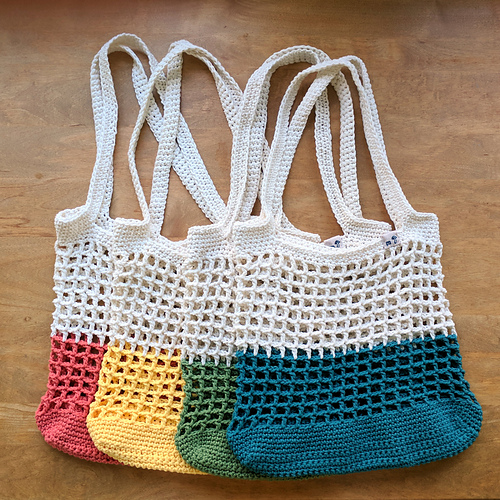
Jenn Palmer. Worsted weight, horizontal stripes and color blocks. The simplest possible introduction to colorwork: you switch colors at row boundaries, no float management, no charts. Mesh sections in the body keep it light enough for groceries.
Structured Handbags
Nordstrom Hobo Bag

Find this pattern on HoneyBee
Dao Lam. Bulky weight, seamless in the round, textured body. The bulky weight finishes the bag fast and gives it shoulder-bag substance without lining. Use a smooth, plied yarn rather than a single-ply or roving — the structure depends on the yarn holding stitch shape.
Starling Handbag

Find this pattern on HoneyBee
Alice Merlino. Worsted weight, structured purse worked in the round. The shape holds entirely from decrease placement, no internal frame. If you want a daily-use bag that doesn't read as a craft project, this is the closest to a commercial silhouette on the list.
Malia Shoulder Bag

Find this pattern on HoneyBee
Rebecca Langford. Worsted weight, bobble-stitch texture with a buttonhole closure. Video tutorial. The bobbles are dense enough that the bag is essentially self-lined — the fabric is too thick for small items to fall through.
Summer Days Daisy Bag
Find this pattern on HoneyBee
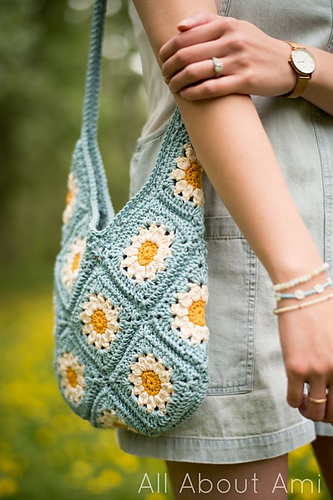
Stephanie Jessica Lau. Worsted weight, daisy-motif construction with photo and video tutorials. The motifs are small enough to be portable; you can make squares on the go and assemble at home.
Specialty Bags
Mosaic Bucket Bag

Find this pattern on HoneyBee
Rebecca Langford. Aran weight, mosaic crochet. Mosaic produces colorwork that looks like tapestry but uses only one color at a time per row — no float management at all. If stranded colorwork has intimidated you, this is the alternative.
Mother of Dragons Dice Bag

Find this pattern on HoneyBee
Rachy Newin. Worsted weight, post-stitch texture, drawstring close. Despite the name, the design works as a catchall pouch, cosmetics bag, or accessories holder. The post stitches build a dense fabric that doesn't snag whatever's inside.
Tips for Bag-Making
Fiber matters more than pattern. Mercerized cotton for market bags. Worsted wool or wool blend for structured handbags. Linen or hemp blends if you want maximum durability. Pure acrylic for bags that need to survive being thrown into a backpack. The same pattern in different fibers produces wildly different finished bags.
Tension on bags should be slightly tight. Most crochet projects benefit from a slightly loose hand. Bags don't. A tighter gauge produces fabric that holds shape under weight rather than stretching out. Go down a half-size hook from the pattern recommendation if your tension runs loose.
Line bags that will carry small items. A simple sewn cotton liner inside an open-weave bag prevents snags and gives the bag professional finish. Sew the liner separately and slip it inside, attaching at the top edge only. Total time investment: 30 minutes for a basic liner.
Add hardware where it helps. Leather or canvas straps on a heavy market tote distribute weight better than crocheted handles. A simple magnetic clasp at the top edge keeps a bucket bag from gaping. None of this is required; all of it elevates the finished piece.
Block the finished bag with stuffing in it. A wet bag drying flat collapses into a wrinkled disc. Stuff it with towels or fabric scraps before letting it dry so it sets the intended three-dimensional shape.
Browse all bag patterns on HoneyBee or filter by tote or purse.
More from the HoneyBee blog
Pattern round-ups, tutorials, and crafting inspiration from the HoneyBee community.
Read more articles